Corporate Background
COVID-19 or Cancer Related Work - CLICK HERE
The need for real-time human impairment detection of cannabinoids was created by the legalization of Medical Marijuana in 42 states + DC combined with the recreational legalization in 24 states. Today, law enforcement, the US Military, and commercial companies with liabilities do not have the means to cheaply and quickly detect human impairment caused from THC (natural cannabinoids) and synthetic cannabinoids. This has resulted in the lack of ability to enforce Driving Under the Influence laws in several states. The capacity for law enforcement to quickly determine cannabinoid impairment by drivers in real-time cheaply and effectively has been a controversial scenario that has lead to disputes in US courts.
CannDetect (TM) has patented technology that was developed to distinguish real-time human impairment during driving or other work related activities without interference from prior medical or recreational use. CannDetect (TM) is the only company with technology capable of determining human impairment in real-time of all cannabinoid molecules. The need for the technology was brought on by the 74% Year-over-Year market sector gain in the Marijuana industry in 2014. The founder of the company was inspired by US Military and law enforcement asking him to create the technology to protect the US Armed forces and civilians from the use of synthetic cannabinoids that were until now undetectable in real-time.
Ironically the liability of the cannabinoid consumer also requires protection from law enforcement, the US military, and commercial companies. The Medical Marijuana consumer has the ethical right to consume a prescribed drug for the medical treatment of a disease by law in 42 US States + DC. The medical patient consumer has also created the demand for real-time validation that he/she is not intoxicated while driving a motor vehicle or operating other heavy machinery. Similarly, the recreational users in the other 24 US States need technology to protect them from traditional cannabinoid detection systems that can not determine human impairment in real-time. Companies need the capacity to document human neural impairment in real-time and remove liability from their daily business when expensive equipment is being used at work or sensitive work is being performed in job roles. Lawyers and judges working in the Judicial System of the US need the capability to provide evidence from the scene of crimes and accidents to determine if human impairment played a role.
This website will be evolving rapidly as the company moves from the research phase into the productization and mass distribution phase.
CannDetection - Patent # US 9,817,007
copyright CannDetect 2014, CannDetect (TM)
"Bad Boys." By Inner Circle, One Way 1987,Bad Boys 1993
CannDetection
The Human brain has a sophisticated endocannabinoid neural network signaling system that is involved in motor neuron control and cognitive thinking tied to the motor neuron control of bodily muscle groups and organs. The Cannabinoid Receptor 1 (CB1) is a glycoprotein intramembrane receptor that can bind with cannabinoids to affect the neural analog electrical signaling in the brain's circuitry. It is here where the work of psychoactive cannabanoids can impair the human brain's cognitive and motor functions.
Distribution of CB1 Receptors in the Human Brain
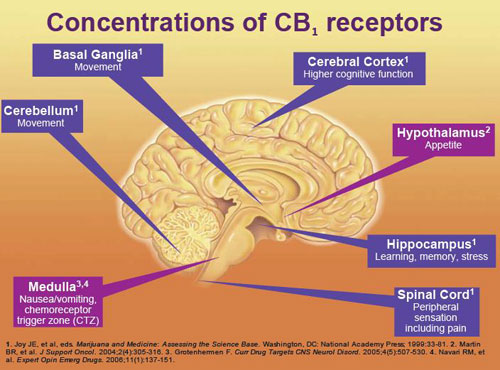
Here at the finite neural junctions of the human brain's analog network are synaptic junctions where the electrical gradients of ionized Calcium (2+), Potassium (1+), and Chlorine (-1) are involved in creating electrical voltage potentials that send signaling across the regions of the brain. This electrical signaling is easily modulated through the binding of psychoactive cannabinoids with the CB1 Receptor at the neural pre/post synaptic junctions. THC is transposable with 2-AG relative to the images displayed here.
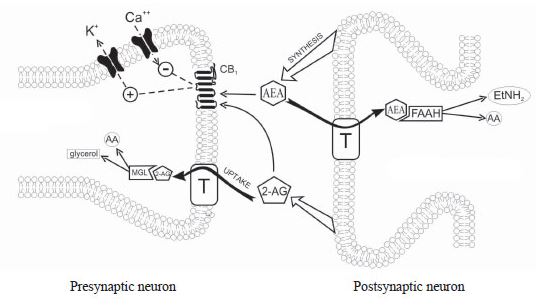
The electrical property of the natural or synthetic cannabinoid is such that it can modulate the neural electro potential to be increased or decreased based on the cannabinoid's chiral molecular center binding structure's affinity for the CB1 Receptor. This has the capacity to excite or inhibit the electro potential gradients of the brain's analog network circuitry.
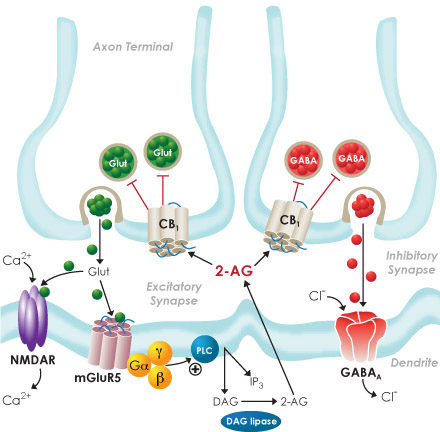
That is 100% measurable as a function of human neural toxicity in the presence of other neural impacting molecules that are capable of traversing the human blood brain barrier. Ethanol and other narcotics may have a throttling affect on the electro potential gradient which is also detectable.
Now, we put that technology into a device about the size of a marker and put it in a human's hand with the capacity to measure human brain impairment by cannabinoid molecules from the 1+ ng/ml range on up in real-time. We add some complex semiconductor EPROM microprocessing of data for analytics and we CannDetect human impairment, the type of cannabanoid(s) impairing the human's brain, and the concentration of actively non-Oxidized psychoactive cannabinoids in a human body.

We leverage the solid state computing platform Raspberry Pi v3 with a quad core ARM Cortex-A53 CPU on Linux with X11 graphics in conjunction with proprietary electronic DC voltage sampling with the ability to sample our neural circuit chip with the CB1 receptor up to 1,000,000 times a second. The 7 inch touch screen tablet is shown here. Our design is as simple as pressing one button after adding the saliva or blood sample to the autosampler. The RPI platform is powerful and allows us to network data wirelessly to remote systems. Data output in terms of the graphical representation or raw ASCII data points sampled in time are available. The image below demonstrates the raw ASCII data output from collection in a LINUX shell (left). That data can be sent downstream to a laptop in a squad car or a database for storage relative to a specific test.
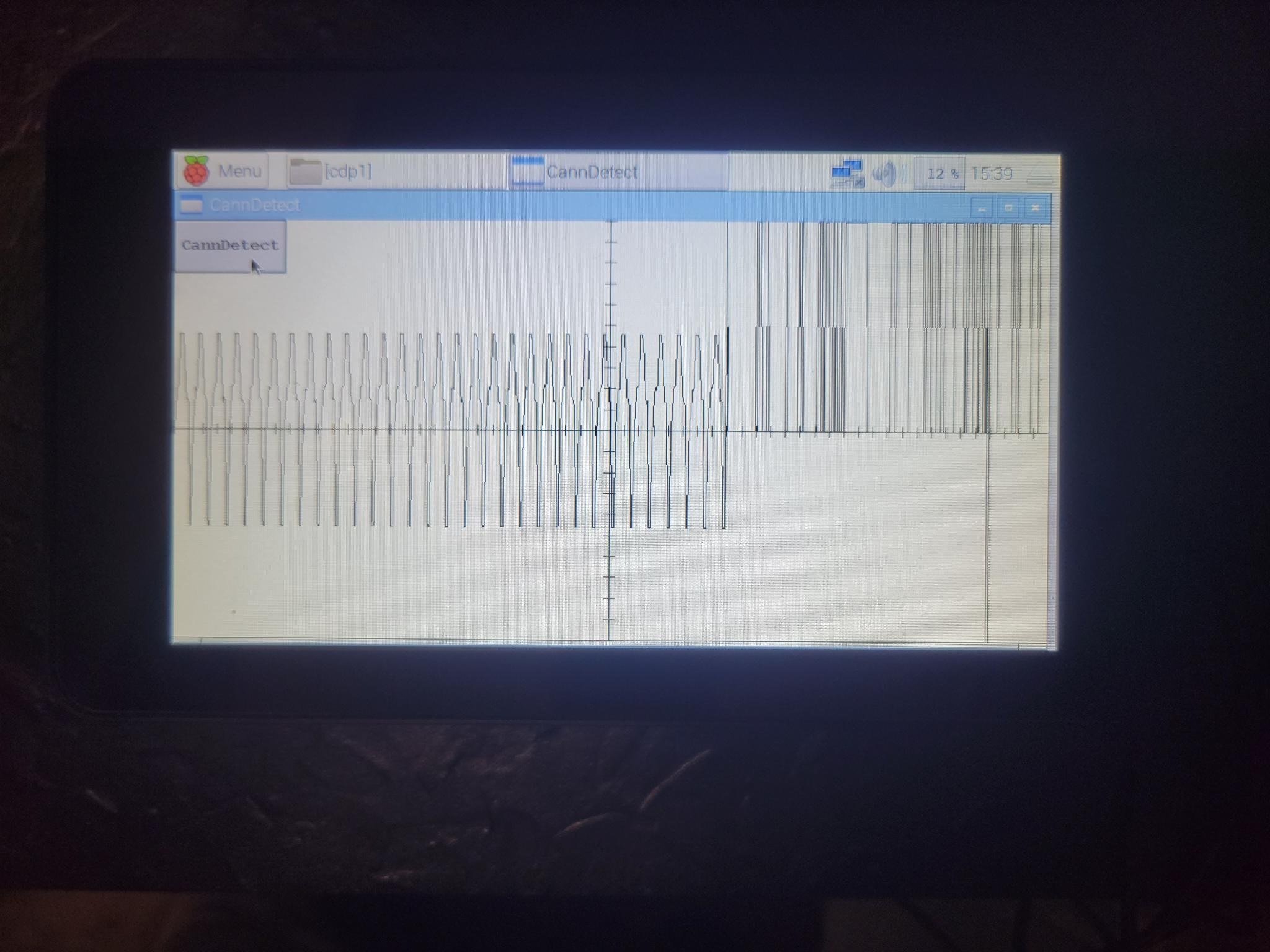
The graphical representation shown is a differential of the DC voltage across a neural circuit. This differential is standardized with THC standards and a GMP manufacturing protocol. The presence of any cannabinoid that binds the CB1 receptor will invoke a differential to the normal circuit DC voltage that is a function of CB1 toxicity relative to the calibration of the instrument. This device is not intended to diagnose a health condition. We may pursue FDA 510k certification in the future. This is an Analytical Chemistry device used to quantify the presence of a CB1 binding cannabinoid relative to known and published cannabinoid binding constants (Ki). The Ki of THC relative to the Human CB1 receptor is well known and published in the Scientific literature, and is a function of the Human neural electrochemistry of the brain's neural circuitry. Patent # US 9,817,007
Please contact us relative to pricing and availability.
Related Literature:
This section of the site is focused on literature cited by experts who work in the fields of science focusing on human impairment by cannabinoids and other narcotics.
Covid19 or Cancer Related Work CLICK HERE
Youtube Senior Citizen Aerosol & Vapor Demo v1 (patent pending 62,993,481)
Youtube Aerosol & Vapor Demo v1 (patent pending 62,993,481)
DOWNLOAD VIDEO: Aerosol AV Sanitizer for Ear, Nose, Throat, and Sinuses (patent pending 62,993,481)
older internet explorer users right click and save as to download the file
DOWNLOAD VIDEO: AV - Vapor Lung Sanitizer (patent pending 62,993,481)
older internet explorer users right click and save as to download the file
Cannabinoid Toxicity Related Work
Washington Courts DUI Sentencing Grid
The Probability of CB1 or CB2 Randomly Folding into a 3D Intramembrane Cannabinoid Receptor
CannDetect Founding
The company was founded by an American Chemist with a MS and a PhD education in Chemistry from the University of Nebraska Lincoln as well as a BA in Chemistry from Mercer University. He is a member of the American Chemical Society and his undergraduate & graduate degrees are certified by the ACS. The founder has two Doctoral Fellowships from the National Institutes of Health and one from UNL. He has an established career in the fields of Chemistry and Information Technology. He is a Genetics subject matter expert who cloned 3 genes. His graduate research focused on "Cancer & Aging." He invented the synthetic replication of chromosomes end-to-end using Polymerase Chain Reaction technology and Telomeric synthetic DNA oligomers. He also invented the telomeric end length PCR reaction commonly used to identify tumors in children by Oncologists worldwide today. He was the first person to ever crystallize a Telomere Binding Protein. He was involved in setting up NIH funded core facilities for analyzing Biochemical & Genetic data at UNL. Some of the founder's graduate school mentors are the following Nobel Laureates: Thomas Cech, Ignacio Tinoco, Peter Klobutcher, Daniel Nathans, Elizabeth Blackburn, Carol Grieder, David Gelfand, and others involving Telomere cancer research. He was mentored by Dr. Robert Hargrove, Chemical warefare weapons expert and Captain of the US Navy in undergraduate studies. He did a COOP with Audiovox during his undergraduate studies at Mercer University in the industrial chemical product space where he founded the chemical product R&D of the company.
Early in life the founder started out as a gamer, a hacker, and a cracker of computer software & hardware in the late 70s and evolved from there. Later in life the founder shifted gears from the Chemistry fields of expertise and focused on information technology and computing as it applied to chemical manufacturing for Amalie. He was involved in developing communications encryption for the US Military under NSA Black Budget projects in the late 1990s. He later moved on into the telecommunications space where he spent 17 years developing sophisticated network engineering analytics and network surveillance products as part of strategic business for Intermedia Communications, MCI-WorldCom, and Verizon. On 9/11/2001 he analyzed the state of NY Empire-Net network communications impact due to terrorist attack for the FBI. He was awarded a patent in SS7 to VOIP call algorithm tracing in Aug, 2014, and developed NSA PRISM feeds for Call Data Records in the 3.3+ billion record per a day volume in C/C++. He is a cybersecurity expert with 9 patents in the telecom space ranging from identity to cybersecurity.
The founder of the company has returned to the field of Biochemistry for the purpose of combining analog networking skills acquired in the telecom industry with complex neural brain networking as humankind emerges toward the Singularity convergence with human made machinery. The emergence of the Singularity in conjunction with the end to prohibition for marijuana and the medicinal applications has created a niche opportunity to create technology related to the next generation neural networking detection of cannabinoid human impairment. The business opportunity combined with the 74% increase year-over-year revenues in the recreation & medical marijuana field along with the issues plaguing law enforcement & the US military with the capacity to detect synthetic cannabinoid impairment in real-time has created a challenge that the founder is interested in from a entrepreneurial perspective.

Corporate:
Tampa, FL
@canndetect
info@canndetect.com
Research & Development:
Seattle, WA
@canndetect